Actualkey Prepration Latest H13-811_V3.5 : HCIA-Cloud Service V3.5: Actual H13-811_V3.5 Exam Questions and Answers PDF's, Verified Answers via Experts - Pass Your Exam For Sure and instant Downloads - "Money Back Guarantee".
| Vendor | Huawei |
| Certification | Huawei Certified ICT Associate |
| Exam Code | H13-811_V3.5 |
| Title | HCIA-Cloud Service V3.5: Actual H13-811_V3.5 Exam |
| No Of Questions | 60 |
| Last Updated | August 31,2026 |
| Product Type | Q & A with Explanation |
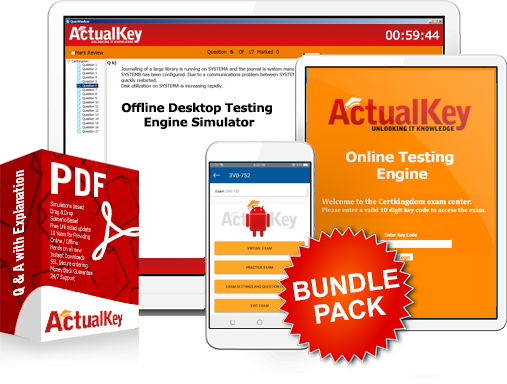
| Bundel Pack Included | PDF + Offline / Andriod Testing Engine and Simulator |
The H13-811_V3.5 HCIA-Cloud Service V3.5 exam is designed for candidates who want to demonstrate foundational cloud computing knowledge and practical understanding of Huawei Cloud services. The certification focuses on cloud concepts, compute, networking, storage, operations and maintenance, databases, security, CDN, and Enterprise Intelligence services.
According to the HCIA-Cloud Service V3.5 exam outline, the major knowledge areas include Cloud Basics (15%), Compute Cloud Services (20%), Network Cloud Services (20%), Storage Cloud Services (20%), HUAWEI CLOUD O&M Basics (15%), and Database, Security, CDN, and EI Services (10%).
Students preparing for the H13-811_V3.5 exam commonly search for H13-811_V3.5 practice questions, HCIA-Cloud Service V3.5 study guides, Huawei Cloud exam preparation, mock tests, sample questions, exam objectives, and online testing engines. Effective preparation should focus on understanding Huawei Cloud services and applying cloud concepts rather than relying solely on memorization.
CertKingdom provides H13-811_V3.5 practice resources designed to help candidates review exam objectives, test their knowledge, identify weak areas, and prepare for the HCIA-Cloud Service V3.5 certification exam.
Topics Covered in H13-811_V3.5 HCIA-Cloud Service V3.5
1. Cloud Basics – 15%
Cloud computing fundamentals
Cloud computing characteristics
Public cloud concepts
Cloud service models
Introduction to Huawei Cloud
Basic cloud architecture
2. Compute Cloud Services – 20%
Elastic Cloud Server (ECS)
Image Management Service (IMS)
Auto Scaling (AS)
Bare Metal Server (BMS)
Cloud Container Engine (CCE)
Other Huawei Cloud compute services
3. Network Cloud Services – 20%
Virtual Private Cloud (VPC)
Elastic IP (EIP)
Elastic Load Balance (ELB)
Virtual Private Network (VPN)
NAT Gateway
Cloud networking concepts and services
4. Storage Cloud Services – 20%
Elastic Volume Service (EVS)
Object Storage Service (OBS)
Scalable File Service (SFS)
Cloud Backup and Recovery (CBR)
Cloud storage concepts
Backup and disaster recovery
5. HUAWEI CLOUD O&M Basics – 15%
Cloud operations and maintenance principles
Identity and Access Management (IAM)
Simple Message Notification (SMN)
Cloud Eye monitoring
Log Tank Service (LTS)
Cloud Trace Service (CTS)
6. Database, Security, CDN, and EI Services – 10%
Database services
Relational Database Service (RDS)
Huawei Cloud security services
Cloud security fundamentals
Content Delivery Network (CDN)
API services
Enterprise Intelligence (EI) services
These objectives are consistent with the published HCIA-Cloud Service V3.5 exam syllabus.
QUESTION 1
Which of the following basic aPaaS services is an out-of-the-box search service designed for enterprise digitalization?
A. KooPhone
B. KooMessage
C. KooSearch
D. KooMap
Answer: C
Explanation:
KooSearch is the Huawei Cloud service specifically designed to provide enterprise-grade search
capabilities with an out-of-the-box service model. Huawei Cloud describes KooSearch as a one-stop
intelligent enterprise search solution built on Cloud Search Service (CSS). It enables organizations to
construct enterprise search, knowledge retrieval, AI search, and document Q&A applications without
having to independently build the underlying search infrastructure. The service integrates enterprise
knowledge sources, search models, vector search capabilities, and other components required for
enterprise information retrieval.
This directly corresponds to the question's description of an out-of-the-box search service designed
for enterprise digitalization. Huawei's current KooSearch documentation explicitly emphasizes its
ready-to-use enterprise search and RAG capabilities. KooPhone is associated with cloud-phone
capabilities, KooMessage concerns enterprise messaging and communication, and KooMap provides
map-related services; none is the dedicated enterprise search offering.
Therefore, KooSearch is the only technically valid choice. This aligns with the HCIA-Cloud Service
domain covering Huawei Cloud platform and other value-added cloud services.
Reference topics: KooSearch Service Overview; Cloud Search Service; Huawei Cloud PaaS/aPaaS Services.
===============
QUESTION 2
Which of the following statements about IAM projects and enterprise projects are incorrect?
A. An enterprise project can contain resources from multiple regions.
B. Enterprise projects group and physically isolate resources in the same region.
C. IAM projects group and logically isolate resources.
D. Resources can be added to or removed from enterprise projects.
Answer: B, C
Explanation:
Options B and C are incorrect because they reverse the isolation characteristics of IAM projects and
enterprise projects. Huawei Cloud defines enterprise projects as a mechanism for grouping and
managing resources across regions. Resources assigned to different enterprise projects are logically
isolated, and a single enterprise project can contain resources residing in multiple regions. Supported
resources can also be added to, removed from, or transferred between enterprise projects.
Consequently, statements A and D correctly describe Enterprise Project Management.
IAM projects operate differently. Huawei Cloud documentation states that IAM projects are regionoriented
and are used to group and physically isolate resources within a region. A project
corresponds to a region, and an IAM project does not provide the cross-region logical grouping
model associated with enterprise projects.
Therefore, B is wrong because it attributes physical, same-region isolation to enterprise projects,
while C is wrong because it attributes logical isolation to IAM projects. The two concepts are
intentionally distinguished in Huawei Cloud architecture: IAM project = regional/physical isolation;
enterprise project = cross-region/logical resource organization.
Reference topics: IAM Projects; Enterprise Projects; Resource Isolation; Enterprise Management.
===============
QUESTION 3
An ECS can be billed on a pay-per-use, yearly or monthly, or spot price basis. Only pay-per-use billing can reduce costs.
A. TRUE
B. FALSE
Answer: B
Explanation:
The statement is false. Huawei Cloud ECS supports multiple billing models, and cost optimization is
not exclusive to pay-per-use billing. The principal modes include yearly/monthly, pay-per-use, and
spot pricing, with each optimized for different workload characteristics.
Pay-per-use is useful for workloads with uncertain or fluctuating demand because resources are
billed according to actual usage and can be released when no longer required. However,
yearly/monthly billing can provide a lower effective price for stable, long-running workloads because
Huawei Cloud applies subscription discounts; the longer the committed subscription period, the
greater the potential discount. Therefore, for predictable production workloads running
continuously, yearly/monthly billing can be substantially more economical than pay-per-use.
Spot pricing is another cost-saving mechanism. Spot instances use market-based pricing and can
provide compute resources at a lower price where workload interruption characteristics permit their
use. Consequently, several ECS billing models can reduce expenditure when aligned to an appropriate workload.
The incorrect portion of the statement is therefore the assertion that only pay-per-use can reduce costs.
Reference topics: Elastic Cloud Server; ECS Billing Modes; Yearly/Monthly; Pay-per-Use; Spot Pricing.
===============
QUESTION 4
Which of the following statements are true about the relationship between account and Identity and Access Management (IAM) users?
A. IAM users only need to pay for the resources that have been authorized by the account. Unauthorized resources do not need to be paid for.
B. An account can revoke the resource usage permissions of IAM users at any time.
C. IAM users do not need to pay for resources. All expenditures are billed to their account.
D. An account can modify the resource usage permissions of IAM users at any time.
Answer: B, C, D
Explanation:
Huawei Cloud establishes a clear parent-child relationship between a Huawei Cloud account and the
IAM users created under that account. The account owns the cloud resources and is the billing entity,
whereas IAM users consume or manage resources according to permissions assigned by the account administrator.
Therefore, option C is correct: IAM users do not independently pay for the resources they use.
Charges generated through their authorized operations are billed to the parent account. Options B
and D are also correct because the account administrator retains authorization control and can
modify or revoke permissions assigned to IAM users.
Option A is incorrect because it incorrectly treats the IAM user as a payment entity. Authorization
determines what an IAM user is permitted to access or operate, not who is responsible for payment.
Huawei Cloud explicitly distinguishes resource ownership and billing from delegated resource access.
An IAM user does not receive an independent bill merely because access to a resource has been authorized.
Accordingly, the correct relationship is: account owns and pays; IAM users operate resources
according to delegated permissions; the account controls those permissions.
Reference topics: IAM Users; Huawei Cloud Accounts; IAM Authorization; Billing Responsibility.
===============
QUESTION 5
Hybrid cloud is a flexible cloud computing model. It may contain two cloud architectures: public
cloud and private cloud, or even more. The infrastructure of a hybrid cloud is owned and operated by
a single organization. Therefore, user services can switch between these clouds as required.
A. TRUE
B. FALSE
Answer: B
Explanation:
The statement is false because its description of infrastructure ownership does not correctly
characterize a hybrid cloud. A hybrid cloud combines different cloud environments"”most commonly
private cloud and public cloud"”and enables workloads, applications, or data to be distributed
between them according to security, capacity, latency, compliance, or business requirements.
Huawei Cloud describes hybrid cloud as a blend of private and public cloud environments. The
private portion may be dedicated to a particular customer and may host confidential or sensitive
workloads, while public cloud resources are delivered through infrastructure operated by a cloud
service provider. Consequently, the combined infrastructure is not inherently owned and operated by
a single organization.
This ownership distinction separates hybrid cloud from a purely private-cloud model. A private cloud
can be dedicated to a single organization, whereas hybrid architecture deliberately combines
environments that may have different infrastructure ownership and operating responsibility.
The statement correctly recognizes that hybrid cloud is flexible and that workloads can use different
cloud environments, but because it makes an absolute and incorrect assertion about singleorganization
ownership, the entire statement must be evaluated as FALSE.
Reference topics: Cloud Deployment Models; Public Cloud; Private Cloud; Hybrid Cloud; CloudPond
Service Overview.
Prepare for the H13-811_V3.5 HCIA-Cloud Service V3.5 exam with CertKingdom practice questions, mock tests, online testing tools and comprehensive Huawei Cloud exam preparation resources.
1. Daniel Foster – United States
“CertKingdom's H13-811_V3.5 practice material helped me understand the Huawei Cloud topics more clearly. The online practice format was especially useful.”
2. Amelia Turner – United Kingdom
“I used the mock tests to identify my weak areas before the exam. The structured practice made my preparation much easier.”
3. Lucas Martin – Canada
“The H13-811_V3.5 study material covered cloud computing, ECS, VPC, OBS, and IAM in a convenient practice format.”
4. Sofia Ramirez – Spain
“I liked being able to practice repeatedly. It helped me become more confident with different question formats.”
5. Ethan Walker – Australia
“The online testing engine was useful for checking my readiness and managing my study time.”
6. Mia Schneider – Germany
“The explanations and topic coverage helped me organize my HCIA-Cloud Service V3.5 preparation.”
7. Noah Bennett – New Zealand
“A helpful resource for practicing Huawei Cloud concepts and reviewing important exam objectives.”
8. Olivia Johnson – Ireland
“I found the practice questions useful for revising cloud networking and storage services.”
9. Matteo Ricci – Italy
“The study resources helped me focus on the major H13-811_V3.5 exam topics instead of studying randomly.”
10. Chloe Dubois – France
“The mock test experience helped me feel more comfortable answering different types of cloud certification questions.”
11. Gabriel Santos – Brazil
“I particularly found the ECS, OBS, VPC, and security practice sections useful during my preparation.”
12. Hannah Williams – South Africa
“The practice engine was simple to use and helped me review topics several times before my exam.”
13. Liam Murphy – Singapore
“A useful preparation resource for anyone studying Huawei Cloud fundamentals and services.”
14. Isabella Cruz – Philippines
“The questions encouraged me to review concepts carefully and improve my understanding of Huawei Cloud services.”
15. Oliver Hansen – Denmark
“CertKingdom provided a convenient way to practice H13-811_V3.5 topics and measure my preparation progress.”
H13-811_V3.5 HCIA-Cloud Service V3.5: Actual H13-811_V3.5 Exam
1. What is the H13-811_V3.5 exam?
H13-811_V3.5 is the exam associated with the HCIA-Cloud Service V3.5 certification and covers foundational Huawei Cloud knowledge and services.
2. What topics are covered in H13-811_V3.5?
The exam covers cloud basics, compute, networking, storage, Huawei Cloud O&M, databases, security, CDN, API, and EI services.
3. How long is the H13-811 exam?
The published HCIA-Cloud Service V3.5 exam outline lists an exam duration of 90 minutes.
4. What question types should I expect?
The official outline lists formats including single-answer, multiple-answer, true/false, fill-in-the-blank, and drag-and-drop items.
5. What is the passing score for H13-811?
The published exam outline lists a passing score of 600 out of 1000.
6. Is H13-811_V3.5 difficult for beginners?
The difficulty depends on previous cloud experience. Beginners should spend additional time learning cloud fundamentals and Huawei Cloud services.
7. How should I prepare for the HCIA-Cloud Service V3.5 exam?
Review every exam domain, study the service concepts, and use practice tests to identify areas requiring additional revision.
8. What is ECS in Huawei Cloud?
Elastic Cloud Server (ECS) is one of the major compute cloud service topics covered in the exam syllabus.
9. What is VPC in Huawei Cloud?
Virtual Private Cloud (VPC) is a core networking topic involving isolated virtual network environments and related cloud networking services.
10. Is OBS included in H13-811_V3.5?
Yes. Object Storage Service (OBS) is included within the Storage Cloud Services section of the syllabus.
11. Is IAM included in the exam?
Yes. Identity and Access Management (IAM) is included under HUAWEI CLOUD O&M Basics.
12. Does the exam cover cloud security?
Yes. Database, Security, CDN, and EI Services are included in the H13-811_V3.5 exam objectives.
13. Does H13-811_V3.5 include networking services?
Yes. Networking topics include VPC, EIP, ELB, VPN, NAT Gateway, and other related services.
14. How many major exam domains are included?
The syllabus is organized into six major knowledge domains.
15. Are practice tests useful for H13-811_V3.5 preparation?
Practice tests can help candidates check their understanding, become familiar with question styles, improve time management, and identify topics requiring further study.
Exams code, certifications, vendor or keywords

Copyright © 2009 - 2026 Actualkey. All rights reserved.