Limited Time 30% Discount Offer Use Code - off30
Actualkey Prepration Latest HPE7-J01 : Advanced HPE Storage Architect Written Exam Questions and Answers PDF's, Verified Answers via Experts - Pass Your Exam For Sure and instant Downloads - "Money Back Guarantee".
| Vendor | HP |
| Certification | ASE |
| Exam Code | HPE7-J01 |
| Title | Advanced HPE Storage Architect Written Exam |
| No Of Questions | 60 |
| Last Updated | September 9,2026 |
| Product Type | Q & A with Explanation |
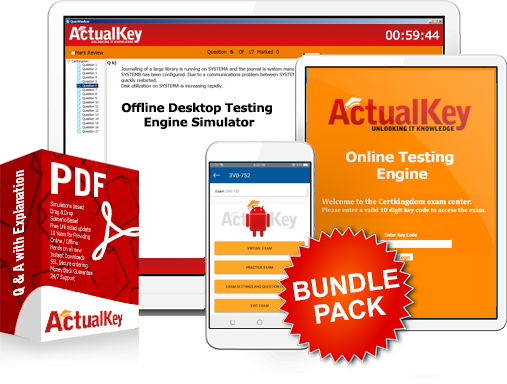
| Bundel Pack Included | PDF + Offline / Andriod Testing Engine and Simulator |
HPE7-J01 Advanced HPE Storage Architect Written Exam
The HPE7-J01 Advanced HPE Storage Architect Written Exam is designed for experienced IT professionals who need advanced skills in architecting, evaluating, and recommending enterprise HPE storage solutions. The exam focuses not only on storage technologies but also on architectural decision-making, customer requirements, solution design, product selection, evaluation, troubleshooting, and complex multi-vendor environments.
HPE lists HPE7-J01 as a proctored exam with 60 questions, 90 minutes, and a 65% passing score. The official preparation resource is the HPE Master ASE - Storage Architect modular curriculum available through HPE Tech Pro.
Candidates preparing for HPE7-J01 should concentrate on scenario-based architectural thinking rather than memorizing isolated product facts. The published objectives emphasize differentiating storage technologies, proposing HPE solutions, evaluating customer requirements, designing storage architectures, assessing solutions, analyzing failures, and evaluating complex or multi-vendor environments.
HPE7-J01 Exam Topics and Objectives
According to HPE's current exam objectives, the major domains include:
1. Foundational Storage Architectures and Technologies — 15%
Candidates should understand how to differentiate, apply, and evaluate foundational storage architectures and technologies.
Important areas include:
Enterprise storage architectures
Block, file, and object storage
SAN and NAS concepts
Storage networking
Storage protocols
Storage performance considerations
Availability and resiliency
Data protection concepts
Storage virtualization
Capacity and performance planning
2. HPE Storage Products, Solutions, Design Components and Services — 25%
This is the largest published objective area.
Preparation should include:
HPE storage portfolio
HPE Alletra solutions
HPE Alletra MP platforms
HPE GreenLake storage solutions
HPE StoreOnce
HPE Primera and related enterprise storage technologies
Storage networking components
Solution components
Warranty and service offerings
Selecting appropriate products for customer requirements
Product integration and architecture
Current third-party practice-question discussions also show scenarios involving products such as Alletra MP, StoreOnce, and HPE storage networking, but these should be treated as supplemental study material rather than official HPE exam content.
3. Storage Market and Customer Requirements — 10%
Candidates should be able to evaluate the storage market and recognize opportunities to apply HPE solutions to customer requirements.
Study areas include:
Customer business requirements
Technical requirements
Workload analysis
Capacity requirements
Performance requirements
Availability requirements
Scalability
Cost optimization
Competitive storage considerations
Matching HPE solutions to business objectives
4. Planning and Designing HPE Storage Solutions — 20%
This domain focuses heavily on architectural decision-making.
Important topics include:
Storage solution planning
Enterprise architecture
Capacity planning
Performance planning
High availability
Disaster recovery
Data protection
Scalability
Storage networking
Virtualization integration
Cloud and hybrid-cloud architectures
Workload requirements
Solution sizing
Design trade-offs
5. Evaluating Storage Solutions — 15%
Candidates should know how to evaluate whether a proposed storage architecture meets technical and business requirements.
Focus on:
Performance evaluation
Capacity evaluation
Availability
Scalability
Resiliency
Data protection
Operational requirements
Solution optimization
Architecture validation
Identifying potential design limitations
6. Enterprise Storage Failures and Solution Improvements — 5%
This domain focuses on analyzing storage failures and recommending architectural improvements.
Study:
Storage failure analysis
Performance bottlenecks
Availability problems
Capacity issues
Connectivity problems
Data protection failures
Root-cause analysis
Corrective actions
Architecture improvements
7. Complex and Multi-Vendor HPE Storage Solutions — 10%
Candidates should understand how HPE storage solutions can operate within complex enterprise environments.
Key areas include:
Multi-vendor storage environments
Interoperability
SAN integration
Server and storage integration
Virtualization environments
Hybrid-cloud environments
Complex enterprise architectures
Migration considerations
Integration challenges
Solution evaluation
These seven domains correspond to HPE's published objective percentages of 15%, 25%, 10%, 20%, 15%, 5%, and 10% respectively.
Prepare for the HPE7-J01 Advanced HPE Storage Architect Written Exam with updated study resources, exam topics, practice questions, and storage architecture preparation.
QUESTION 1
A storage administrator wants to set up NAS replication between two HPE StoreOnce appliances. A
corresponding NAS library was created between the two systems, primary and secondary, where the
secondary will receive the replicated information. When the administrator tries to create the NAS
mapping on the primary StoreOnce solution, the administrator is presented with an error stating
they do not have permission. What should the administrator do to solve this issue?
A. On the primary StoreOnce appliance, generate an access token and configure this token on thesecondary StoreOnce appliance.
B. On the secondary StoreOnce appliance, set the Replication Permissions to allow Enabled Public Access.
C. On the secondary StoreOnce appliance, define the primary StoreOnce appliance, along with the respective username and password.
D. On the primary StoreOnce appliance, define the secondary StoreOnce appliance, along with the respective username and password.
Answer: C
Explanation:
In the context of HPE StoreOnce Catalyst and NAS replication, security is governed by a bi-directional
trust or permission-based handshake. When configuring replication between two StoreOnce
appliances, the "Target" (Secondary) system acts as the gatekeeper. The error described occurs
because the primary system is attempting to push data or create a mapping to a destination that has
not authorized it.
According to the HPE StoreOnce documentation regarding Replication Permissions, the secondary
appliance must explicitly grant permission to the source appliance before any mapping or data
transfer can occur. This is a security measure designed to prevent unauthorized data ingestion or
"rogue" replication tasks from consuming storage resources on the target system. To resolve the
permission error, the administrator must log into the Secondary StoreOnce appliance (the target) and
navigate to the replication settings. There, they must add the Primary StoreOnce appliance as an
authorized "source" by specifying its network address (FQDN or IP) and providing the necessary
credentials (username and password) that the primary system will use to authenticate.
Unlike simpler protocols where a "Public Access" setting (Option B) might exist, HPE StoreOnce
requires a defined relationship for NAS and Catalyst replication to ensure data integrity and multitenancy
security. Option A refers to token-based authentication, which is more common in modern
cloud-native Alletra environments via DSCC, but not the standard for legacy StoreOnce NAS
replication. Options D is incorrect because the permission must be granted at the receiving end, not
the sending end. Once the secondary system has the primary's details stored in its Replication
Permissions list, the primary appliance will be able to successfully "discover" the target libraries and
establish the mapping without further permission errors.
QUESTION 2
A customer wants to implement HPE Cloud Bank Storage with the detach option LTU feature. Which
statement is correct regarding the implementation of this feature?
A. HPE Cloud Bank Store must be connected using the connect (read-write) option.
B. A detached Cloud Bank datastore can only be reconnected to the HPE StoreOnce system from which it was detached.
C. HPE Services is always required when reconnecting a detached datastore.
D. Support for reading and writing to the detached datastore is supported with the detach license installed.
Answer: A
Explanation:
HPE Cloud Bank Storage is an extension of HPE StoreOnce Catalyst that enables the movement of
deduplicated data to public, private, or hybrid cloud object storage. The Cloud Bank Detach feature is
a critical lifecycle management capability designed for long-term retention and disaster recovery scenarios.
According to the HPE StoreOnce User Guide, the "Detach" operation is a specific administrative
action that essentially "unplugs" the Catalyst store from the local StoreOnce appliance while leaving
the data intact in the cloud bucket (e.g., AWS S3 or Azure Blob). For an administrator to initiate the
detach process, the Cloud Bank store must currently be in a Read-Write (RW) state on the StoreOnce
system. If a store is currently connected as Read-Only (often the case after a disaster recovery sync),
it cannot be detached until it is promoted or was originally connected in a Read-Write capacity.
Once the detach operation is executed using the required Detach Capacity LTU (License to Use), the
store enters a "Detached" state. In this state, the data in the cloud becomes immutable and the store
is removed from the local StoreOnce system's active management. It is important to note that once
detached, the store can only be reconnected to a StoreOnce system (either the original or a new one
for DR) in a Read-Only state for recovery purposes. Statement D is incorrect because you cannot
write to a detached store. Statement B is incorrect because one of the primary value propositions of
Cloud Bank is portability—allowing you to connect a detached store to a completely different
StoreOnce appliance in a different region for recovery. Finally, while HPE Services are available for
complex DR planning, they are not a technical requirement for the software-defined reconnection of a detached store.
QUESTION 3
A customer is interested in a backup repository solution with long-term data retention. The customer
has the following requirements:
Needs to leverage secondary storage for development operations and development testing
Fast granular restore and instant recovery features
Cost-effective, yet scalable solution that provides built-in replication features
What is the best solution for this customer?
A. HPE Alletra 5000s and Veeam
B. HPE dHCI and Cohesity
C. HPE Alletra 5000s and Scality RING
D. HPE Alletra 4000s and Commvault
Answer: A
Explanation:
The requirements provided point toward a "Secondary Storage" use case where the data must be
more than just a "cold" backup; it needs to be "active" for DevOps and testing. The HPE Alletra 5000
(the successor to the HPE Nimble Storage Adaptive Flash arrays) is specifically engineered for this
hybrid role.
Architecturally, the Alletra 5000 utilizes the CASL (Content Aware Storage Architecture) file system.
This allows it to perform high-speed inline deduplication and compression, making it a cost-effective
repository for long-term retention. Crucially for the customer's DevOps requirement, Alletra 5000
supports Zero-Copy Clones. This means the storage administrator can instantly create multiple copies
of production datasets for development and testing without consuming additional storage space or
impacting the performance of the primary backup repository.
When paired with Veeam Backup & Replication, the solution meets the "fast granular restore" and
"instant recovery" requirements perfectly. Veeam's vPower technology enables Instant VM Recovery,
which allows a virtual machine to be started directly from the compressed and deduplicated backup
file on the Alletra 5000. Because the Alletra 5000 includes a flash tier for metadata and frequently
accessed data, it provides the necessary IOPS to run these recovered VMs or DevTest workloads with
near-production performance.
In contrast, while Cohesity (Option B) is a strong secondary platform, HPE dHCI is a primary
infrastructure solution and not just a backup repository. Scality RING (Option C) is an object storage
solution geared toward massive scale and petabyte-level archives, but it lacks the performance
characteristics for "instant recovery" and seamless DevOps cloning found in the Alletra 5000. HPE
Alletra 4000 (Option D) is a high-density data server (formerly Apollo) which provides the raw
hardware but lacks the integrated CASL-based intelligence and "Better Together" orchestration that
the Alletra 5000/Veeam partnership offers for this specific customer profile.
QUESTION 4
Which HPE system can be integrated into a factory-built HPE Qumulo solution for a customer?
A. HPE Apollo 4200
B. HPE Alletra 5000
C. HPE ProLiant 360
D. HPE Apollo 4500
Answer: A
Explanation:
The HPE Solutions for Qumulo are a result of a strategic partnership designed to provide a highperformance,
scale-out NAS (Network Attached Storage) platform for unstructured data. According
to the HPE Solutions with Qumulo Reference Architecture, the primary hardware platform utilized for
these factory-built, integrated solutions is the HPE Apollo 4000 series, specifically the HPE Apollo 4200.
The Apollo 4200 is chosen for this role because it is a density-optimized, storage-centric server that
provides an ideal balance of compute and massive internal storage capacity within a standard 2U
rack footprint. Architecturally, the Apollo 4200 supports an "SSD-first" hybrid configuration or an allflash
configuration, which aligns perfectly with Qumulo's file system requirements. Qumulo's
software uses the SSDs for a high-speed metadata layer and write-cache, while utilizing high-capacity
HDDs for the data plane, ensuring that even with billions of files, the system maintains near-flash performance.
While the HPE ProLiant DL325 is also used for specific all-NVMe nodes in the Qumulo portfolio, the
Apollo 4200 remains the foundational building block for the hybrid and archive nodes that comprise
the bulk of enterprise deployments. The HPE Apollo 4500 (Option D) is a 4U system that, while part
of the Apollo family, is not the standard integrated platform for the mainstream Qumulo joint
offering. The HPE Alletra 5000 (Option B) is a block-storage-focused platform derived from the
Nimble lineage, and the ProLiant DL360 (Option C) is a general-purpose 1U compute server that lacks
the internal drive density required for a high-capacity scale-out file storage solution. By selecting the
Apollo 4200, customers benefit from a pre-validated, factory-integrated solution that simplifies the
deployment of massive file lakes for workloads like video surveillance, medical imaging, and big data analytics.
QUESTION 5
HOTSPOT
An administrator wants to build a scale-out solution using two HPE Alletra 6000 storage arrays. Only
the first array has been initialized. Use your cursor to place a + where the administrator can add the
second uninitialized array to the first storage array.
Answer:
Explanation:
Hardware
To expand a single-array configuration into a multi-array scale-out cluster (known as an HPE
Nimble/Alletra 6000 Group), the administrator must navigate to the physical resource management
section of the interface. In the HPE Alletra 6000 and legacy Nimble Storage UI, this is located under
the Hardware tab in the primary navigation menu.
Once the administrator clicks on Hardware, the system displays the "Arrays" view. If a second,
uninitialized Alletra 6000 array is physically connected to the same network and has been discovered
by the management software (via the Discovery protocol), it will appear in a list of "Discovered
Arrays" or within the main hardware pane with an option to be added to the current group. By
selecting the uninitialized array and clicking the add/plus icon within that specific Hardware submenu,
the administrator triggers the group expansion process. This process non-disruptively
integrates the new array's controllers and capacity into the existing management plane, allowing for
seamless data migration and performance scaling across the member arrays.
The exhibit provided (image_64b359.png) currently shows the Data Protection sub-tab under the
Manage menu. This area is dedicated to managing volume collections, snapshots, and replication
partners rather than hardware membership. To perform the hardware-level task of adding a new
physical node to the cluster, the administrator must first move away from the "Manage" view and
select Hardware. This architectural separation ensures that logical data management tasks are
distinct from physical infrastructure scaling. Once the second array is added, the "Manage" view will
then reflect the combined resources of both arrays, allowing for group-wide volumes that can span
the performance and capacity of the entire scale-out solution.
HPE7-J01 exam preparation covering HPE storage architecture, solution design, Alletra, GreenLake, data protection, scalability, performance, and multi-vendor environments.
Daniel Mwangi - Kenya
“The HPE7-J01 practice material helped me organize my preparation around storage architecture and solution design.”
Sofia Bennett - United Kingdom
“I found the scenario-based questions useful for understanding how to approach architectural decisions.”
Arjun Nair - India
“The structured HPE7-J01 topics made it much easier to identify the areas I needed to revise.”
Lucas Pereira - Brazil
“The practice questions gave me a better understanding of enterprise storage design concepts.”
Mariam Hassan - Egypt
“The HPE7-J01 preparation content was easy to navigate and helped me build a focused study plan.”
Ethan Williams - Australia
“I particularly liked the sections covering performance, scalability, availability, and storage architecture.”
Kenji Tanaka - Japan
“The exam-focused study material helped me review important HPE storage concepts efficiently.”
Noah Martin - Canada
“The questions encouraged me to think about why one storage architecture would be better than another.”
Amina Diallo - Senegal
“The HPE7-J01 study topics helped me prioritize the areas with the greatest relevance to the exam objectives.”
Mateo García - Spain
“The preparation material provided a useful way to review storage design and enterprise solution planning.”
Oliver Schmidt - Germany
“The combination of technical concepts and scenario-based preparation was helpful for my exam planning.”
Ravi Perera - Sri Lanka
“I used the practice questions alongside my technical study and found them useful for checking my understanding.”
Nadia Rahman - Bangladesh
“The HPE7-J01 content helped me create a more organized revision schedule.”
Samuel Okoro - Nigeria
“The storage architecture topics were clearly organized and helped me focus my preparation.”
Pierre Dubois - France
“The preparation material was useful for reviewing enterprise storage design, performance, and solution evaluation.”
Get HPE7-J01 exam preparation resources covering official objectives, storage architecture, HPE solutions, design scenarios, troubleshooting, and practice questions.
For SEO and credibility, I recommend not making an unsupported claim such as “Actualkey is the best dumps provider.” A stronger, more trustworthy snippet is:
Actualkey provides HPE7-J01 exam preparation resources, practice questions, study materials, and exam-focused learning content for storage professionals.
HPE7-J01 Advanced HPE Storage Architect Written Exam
1. What is HPE7-J01?
HPE7-J01 is the Advanced HPE Storage Architect Written Exam, associated with the HPE Master ASE Storage Architect certification path. HPE describes it as an exam validating advanced ability to design, install, configure, and manage HPE storage and backup solutions.
2. How many questions are on HPE7-J01?
HPE's current exam data card lists 60 questions.
3. How long is the HPE7-J01 exam?
The official HPE exam page lists a 90-minute exam duration.
4. What is the HPE7-J01 passing score?
The current HPE exam data card lists a 65% passing score.
5. What languages are available?
HPE currently lists English, Japanese, and Korean as delivery languages.
6. Is HPE7-J01 difficult?
It is an advanced architect-level examination. Its objectives emphasize evaluating requirements, proposing solutions, planning and designing architectures, evaluating solutions, analyzing failures, and handling complex or multi-vendor environments.
7. What are the most important HPE7-J01 topics?
The largest objective is proposing HPE storage products, solutions, design components, and service offerings at 25%, followed by planning and designing HPE storage solutions at 20%.
8. Does HPE7-J01 focus only on HPE products?
No. The objectives also require understanding foundational storage architectures and technologies, evaluating the storage market, and evaluating complex and multi-vendor HPE storage solutions.
9. Should I have hands-on storage experience?
Practical enterprise storage experience can be valuable because the exam is focused on architectural decisions and applying technologies to customer and business requirements. HPE describes the exam as validating a combination of advanced design expertise and practical field experience.
10. What should I study for HPE7-J01?
Start with HPE's official exam objectives and preparation resources, then study storage architecture, HPE storage solutions, solution planning, design, evaluation, troubleshooting, and multi-vendor environments.
11. Are HPE7-J01 practice tests useful?
Practice tests can help identify knowledge gaps, improve time management, and become familiar with scenario-based reasoning. They should supplement—not replace—official documentation and technical training.
12. Where should I get HPE7-J01 study material?
HPE lists the HPE Master ASE - Storage Architect modular curriculum as an exam preparation resource.
13. What storage technologies should I understand?
Candidates should have a strong understanding of enterprise storage architectures, storage networking, data protection, performance, availability, scalability, and solution design, alongside relevant HPE technologies.
14. How can I prepare for HPE7-J01?
Review the official objectives, study the relevant HPE storage technologies, work through architecture scenarios, practice evaluating customer requirements, and use practice questions to identify weak areas.
15. Is HPE7-J01 suitable for storage architects?
Yes. The exam is specifically positioned around advanced storage architecture and evaluates the ability to design and evaluate enterprise HPE storage solutions.
I Got My Success Due To Actualkey HPE7-J01 Bundle Pack Actualkey experts I got passed in the HPE7-J01 exam without any worries at all, these exam material products gave me the reason to relax.
Budi Saptarmat
Yahoo! Got Successfully Through The HPE7-J01 Exam Passing Exam is not a easy thanks to Acutalkey.com for providing me actual HPE7-J01 Advanced HPE Storage Architect Written Exam training with there included the Offline and Android simulators helps me success
Melinda
HPE7-J01 Exam Best Preparation I have been preparing for HPE7-J01 Advanced HPE Storage Architect Written Exam, I was not sure that I'll be able to pass because of the fact that I am not a good student however;Actualkey.com provided me best and simple exam training pdf's and I passed. I now recommend everyone
Antonio Moreno
Actualkey.com HPE7-J01 Offline Simulator is Best My choice to select Actualkey.com and go for the preparation HPE7-J01 Advanced HPE Storage Architect Written Exam, because I got the short way with the easy way
Liliane Meichner
Actualkey.com HPE7-J01 Exam PDF"s passed with in a week HPE7-J01 exam pdf's that's amazing
James Wilson
HP - RELATED EXAMS
Planning & Design of HP Integrity Entry-Level Server Solutions
Questions: 140 | August 1, 2024
Configuration & Management of HP Integrity Mid-range Servers
Questions: 140 | August 1, 2024
OVIS/OVTA - OpenView Internet Services and OpenView Transaction Analyzer
Questions: 70 | August 1, 2024
Implementing Windows Server 2003 on HP ProLiant Cluster Solutions
Questions: 69 | August 1, 2024
Tru64T UNIX v5 System Administration, Support, and Integration
Questions: 154 | January 5, 2024
HP Enterprise Integration and Management of HP ProLiant Servers
Questions: 107 | May 8, 2024
Integrating and Managing HP ProLiant ML/DL Servers in the Enterprise
Questions: 248 | January 7, 2024
Planning and Designing ProLiant Solutions for the Enterprise Exam
Questions: 135 | January 5, 2024
Planning and Designing HP Enterprise Solutions HP Virtual Training
Questions: 273 | January 5, 2024
HP Integrity Server Multi-OS Installation and Deployment Exam
Questions: 147 | January 5, 2024
Integrating and Managing HP BladeSystem in the Enterprise Exam
Questions: 190 | January 5, 2024
Designing & Implementing HP Enterprise Backup Solutions Exam
Questions: 92 | January 5, 2024
Planning and Designing ProLiant Solutions for the Enterprise
Questions: 132 | January 5, 2024
Planning and Designing HP Enterprise Solutions Exam Certification
Questions: 120 | January 5, 2024
Integrating and Managing HP BladeSystem in the Enterprise Exams
Questions: 182 | May 8, 2024
Implementing XP24000, XP20000, XP12000, XP10000 Solution Fundamentals
Questions: 59 | January 8, 2024
Designing and Implementing HP Enterprise Backup Solutions Exam
Questions: 85 | January 8, 2024
Intergrating & Managing HP Blade System Solutions in Enterprise
Questions: 208 | July 1, 2024
Planning and Designing HP Converged Infrastructure Solutions
Questions: 128 | August 1, 2024
HP Color LaserJet CP6015 and CM6040 MFP Service Qualification
Questions: 28 | August 1, 2024
Technical Introduction to the HP Enterprise Portfolio,Rev. 11.41
Questions: 144 | May 8, 2024
Technical Essentials of HP Servers, Storage and Networking - Upgrade
Questions: 72 | May 7, 2024
HP Imaging and Printing Management and Security Solutions-Technical
Questions: 40 | May 7, 2024
Selling HP Cloudsystem and Converged Infrastructure Solutions Delta Exam
Questions: 40 | May 7, 2024
HP TippingPoint Next Generation Firewall Security Products Professional
Questions: 42 | July 1, 2024
Introduction to Selling Servers, Storage, Networking and Services
Questions: 70 | January 15, 2024
HP LaserJet Enterprise 600 M601, M602, and M603 Series Printer Service and Support
Questions: 20 | January 15, 2024
Selling HP Automation and Cloud Management Software Solutions
Questions: 51 | January 17, 2024
Integrating and Managing HP ProLiant ML/DL in the Enterprise
Questions: 63 | September 16, 2024
Delta - Selling HP Printing and Personal Systems Hardware
Questions: 151 | September 16, 2024
NonStop Application Design and Development Master
Questions: coming soon | September 16, 2024
Delta - Selling HP Enterprise Storage Solutions and Services
Questions: 40 | January 19, 2024
Delta - Designing HPE Enterprise Storage and Backup Solutions
Questions: 50 | January 19, 2024
Selling HPE Information Management and Information Governance Solutions
Questions: 40 | April 11, 2024
Fast Track - Applying Aruba Switching Fundamentals for Mobility
Questions: 62 | April 11, 2024
Introduction to Selling HPE Products, Solutions and Services
Questions: 125 | April 11, 2024
Implementing HP JetAdvantage Secure Print and Insights 2019
Questions: 35 | January 21, 2024
HP Introduction to Selling HPE Products, Solutions and Services Exam
Questions: 60 | January 21, 2024
Designing HPE Software-Defined Infrastructure Solutions Exam
Questions: 87 | November 8, 2024
Selling HP Lifecycle Services for Workforce Computing 2025 exam
Questions: 24 | March 11, 2026
Exams code, certifications, vendor or keywords

Copyright © 2009 - 2026 Actualkey. All rights reserved.