Actualkey Prepration Latest Comm-Dev-101 : Salesforce Certified B2C Commerce Developer Exam Questions and Answers PDF's, Verified Answers via Experts - Pass Your Exam For Sure and instant Downloads - "Money Back Guarantee".
| Vendor | Salesforce |
| Certification | Salesforce Certified Administrator |
| Exam Code | Comm-Dev-101 |
| Title | Salesforce Certified B2C Commerce Developer Exam |
| No Of Questions | 170 |
| Last Updated | October 27,2026 |
| Product Type | Q & A with Explanation |
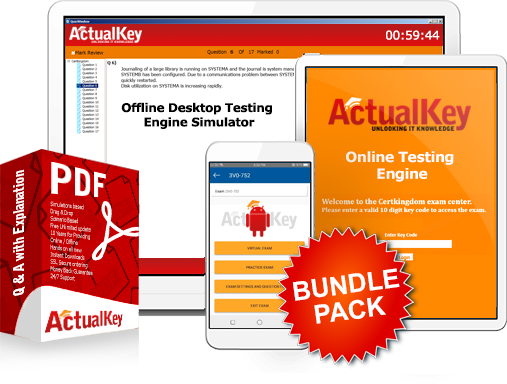
| Bundel Pack Included | PDF + Offline / Andriod Testing Engine and Simulator |
Comm-Dev-101 Salesforce Certified B2C Commerce Developer Exam
I’ve based the exam facts and objectives on Salesforce’s published exam guide; Salesforce lists the exam at 60 scored questions plus up to five unscored questions, 105 minutes, and a 65% passing score. Salesforce
Exam Overview
* Exam Name: Salesforce Certified B2C Commerce Developer
* Exam Code: Comm-Dev-101
* Registration Price: $200.00 USD (plus applicable taxes)
* Retake Price: $100.00 USD (plus applicable taxes)
* Duration: 105 minutes
* Number of Questions: 60 scored multiple-choice/multiple-select questions (plus up to 5 non-scored questions, total ~65)
* Passing Score: 65%
* Prerequisites: None officially required, though recommended experience is 1 year of general development and 3–6 months of B2C Commerce development.
Recommended Training & Preparation
* Classes / Courses:
* B2C Commerce Developer with SFRA
* Manage and Merchandise a B2C Commerce Cloud Store
Comm-Dev-101 Salesforce Certified B2C Commerce Developer Exam
The Salesforce Certified B2C Commerce Developer (Comm-Dev-101) certification is designed for developers who build and customize ecommerce solutions using Salesforce B2C Commerce. Key preparation areas include SFRA, Business Manager, ISML templates, JavaScript controllers, Page Designer, Forms Framework, OCAPI, jobs, integrations, troubleshooting, performance, and scalable development. Salesforce
Certkingdom provides Comm-Dev-101 exam preparation resources, practice questions, study materials, and exam*focused learning content to help candidates prepare efficiently.
Topics Covered in Comm-Dev-101
According to Salesforce's published exam outline, the major domains are
B2C Commerce Setup (11%)
Work With a B2C Site (12%)
Data Management Using Business Manager (24%)
Application Development (53%).
* B2C Commerce architecture and setup
* Business Manager
* Sandbox configuration
* IDE and WebDAV
* Cartridge paths and deployment
* Product catalogs and product data
* Inventory and price books
* Payment and shipping configuration
* SFRA architecture
* ISML templates
* JavaScript controllers
* Models, decorators, factories, and helpers
* Page Designer
* Content Slots
* Forms Framework
* CSRF protection
* Localization
* Custom objects
* Logging and debugging
* Services and integrations
* Hooks
* OCAPI Shop and Data APIs
* Data import/export
* Jobs and scheduled processes
* Performance and scalability
* Troubleshooting and best practices
What Students Search on Google, ChatGPT, Copilot, DeepSeek, Gemini, Reddit & YouTube
* What is Comm-Dev-101?
* How do I prepare for the Salesforce B2C Commerce Developer exam?
* What topics are covered in Comm-Dev-101?
* Is Salesforce B2C Commerce Developer difficult?
* How many questions are on Comm-Dev-101?
* What is the Comm-Dev-101 passing score?
* What is SFRA in Salesforce B2C Commerce?
* How should I study ISML templates?
* What are the most important Comm-Dev-101 topics?
* Where can I find Comm-Dev-101 practice questions?
* What are the best Salesforce B2C Commerce Developer study resources?
* How do OCAPI Shop and Data APIs work?
* What should I know about Business Manager for Comm-Dev-101?
* How are Page Designer questions tested?
* What are common Comm-Dev-101 exam mistakes?
* How can I practice Salesforce B2C Commerce development?
* What are the important SFRA interview and exam questions?
* Is hands*on B2C Commerce experience required?
* What should I study before taking Comm-Dev-101?
* What is the best way to pass the Salesforce B2C Commerce Developer certification?
Prepare for the Salesforce Comm-Dev-101 B2C Commerce Developer exam with focused practice questions, study materials, SFRA topics, Business Manager, ISML, OCAPI, Page Designer, and application development resources from Certkingdom.
QUESTION 1
You have been assigned to set up a new B2C Commerce site for a multi-currency retailer. The business
requires that product prices be displayed in both USD and EUR, with tax calculations applied automatically
based on the customer's shipping destination. In Business Manager, you need to complete the initial site
configuration. Which two tasks must you perform during site creation to meet these requirements?
A. Configure the default currency to USD and set the taxation type to 'Destination-based' during site creation
B. Create separate product catalogs for USD and EUR pricing in the Products module
C. Enable multi-currency support and configure pricebooks for each currency in the site settings
D. Modify the product data model to add a custom currency attribute to each product
E. Use the Global Commerce Search preferences to enable currency filtering on the storefront
Answer: A, C
Explanation:
During B2C Commerce site creation in Business Manager, you must configure the default currency (which will
be USD in this case) and set the taxation type to destination-based to support tax calculation based on shipping
location. Additionally, you must enable multi-currency support and configure pricebooks for each supported
currency (USD and EUR) in the site settings. This is typically done in the site configuration and pricebook assignment areas.
Creating separate product catalogs is unnecessary and would complicate inventory management. Modifying
the product data model with custom currency attributes is not the correct approach—B2C Commerce handles
multi-currency through pricebooks. Global Commerce Search preferences control search behavior, not currency or tax configuration.
QUESTION 2
You are configuring a new B2C Commerce site in Business Manager and need to set up the foundation for a
European storefront that will sell products in multiple currencies and apply VAT (Value Added Tax) to all
orders. During the site creation process, you are presented with options for configuring the default currency and taxation type.
Which two of the following actions should you take to meet these business requirements?
A. Set the default currency to EUR and select 'Net' as the taxation type to calculate tax before applying to the order subtotal
B. Set the default currency to EUR and select 'Gross' as the taxation type so that VAT is included in product prices
C. Set the default currency to USD and configure a currency converter to automatically convert to EUR at checkout
D. Set the default currency to EUR and enable 'Gross Tax Inclusive Pricing' so that all displayed prices include VAT
E. Set the taxation type to 'Exempt' initially and configure tax rules later through the pricebooks module
Answer: B, D
Explanation:
When setting up a European site with VAT requirements, you must configure two key aspects: the default
currency (EUR for European operations) and the taxation type (Gross for VAT-inclusive pricing). In B2C
Commerce, selecting 'Gross' as the taxation type means that product prices include all applicable taxes, which
is the standard approach for European VAT compliance. Additionally, enabling 'Gross Tax Inclusive Pricing'
ensures that the prices displayed to shoppers already include VAT, eliminating the need for tax calculations at checkout.
Why the other options are incorrect: Setting the taxation type to 'Net' means taxes are calculated and
added on top of the subtotal—appropriate for regions like the US, not Europe. Using USD as the default
currency would confuse both customers and internal operations in a European context. Configuring 'Exempt'
taxation type is used for tax-free scenarios and does not support VAT compliance. Currency conversion at
checkout is not a standard Business Manager feature for site setup; currency handling is managed through
pricebooks and multi-currency configurations.
QUESTION 3
You are setting up a new B2C Commerce site in a sandbox environment. The business requires the site to
operate in EUR currency with VAT-based taxation for European customers. After creating the site in Business
Manager, you need to configure the storefront data. Which of the following steps should you perform to
ensure the site is properly configured for these requirements? Select all that apply.
A. In Site Preferences, set the default currency to EUR and configure the taxation type to use VAT-based tax calculation
B. Create a new tax jurisdiction in Business Manager and assign it to the site before configuring the currency
C. Assign pricebooks that are denominated in EUR to the site catalog and storefront configuration
D. Deploy a custom cartridge to handle EUR currency conversion on the fly during checkout
E. Configure OCAPI Data API permissions to restrict currency queries to EUR only
Answer: A, C
Explanation:
When setting up a new B2C site with specific currency and taxation requirements, you must configure the site's
default currency and tax settings in Business Manager's Site Preferences. The default currency (EUR in this
case) is set at the site level, and the taxation type (VAT-based) is configured as part of the site's general
settings. Additionally, you must assign pricebooks denominated in the correct currency to ensure pricing
displays correctly on the storefront.
The incorrect options reflect common misconceptions: tax jurisdictions are separate from the initial site setup
and don't need to be created before currency configuration; custom cartridges are not used for basic currency
handling (that's a core platform function); and OCAPI permissions control API access patterns, not currency conversion.
QUESTION 4
Your team is implementing a new feature that requires storing custom information about customer
preferences for product recommendations. This data needs to persist across sessions and be queryable by
business logic in controllers. The requirement specifies that you need to store an array of preferred product
categories and a last-updated timestamp for each customer. Which approach best addresses this requirement?
A. Create a custom object type extending dw.object.PersistentObject with attributes for preferred categories and timestamp, then instantiate and query it in your controller logic
B. Store the preference data as a serialized JSON string in the customer's profile custom attributes using the existing Customer object
C. Create a temporary in-memory JavaScript object in the session scope and populate it on each request from a properties file
D. Extend the Product system object to include a customer preference attribute for each category
E. Use OCAPI Shop API to store preference data in an external third-party system on each customer interaction
Answer: A
Explanation:
When you need to store custom, queryable data that persists beyond a single session, B2C Commerce provides
custom objects that extend dw.object.PersistentObject. This allows you to define a dedicated data
structure with specific attributes (arrays, timestamps, etc.) that can be queried using the Query API, making it
ideal for features like recommendation preferences.
Storing in customer profile custom attributes (option B) works for simple scalar values but is not designed for
https://certkingdom.com
complex queryable data structures like arrays. In-memory session objects (option C) don't persist. Extending
the Product system object (option D) would pollute the product model with customer-specific data. OCAPI and
external systems (option E) add unnecessary complexity and latency for what should be a direct persistence need.
QUESTION 5
You are debugging a performance issue where product search queries are taking longer than expected
during peak traffic hours. Using Business Manager's logging and monitoring tools, you've identified that
search indexing operations are contributing to the latency. You also notice that the same search refinements
are being calculated repeatedly without changing results. Which of the following represents the best
combination of actions to resolve this issue?
A. Enable persistent caching for search refinement definitions in the search preferences and configure a
longer reindex interval for the product search index to reduce how frequently it rebuilds
B. Modify all ISML templates to cache search results in the session scope for 5 minutes and disable realtime
product inventory updates
C. Remove all custom search refinements from the configuration and use only out-of-the-box categorybased
navigation instead
D. Configure OCAPI Shop API caching headers to cache search responses for 24 hours on the CDN layer
E. Use the Business Manager Job Scheduler to reindex products every 30 seconds to ensure search data is
always current
Answer: A
Explanation:
Search performance issues related to refinement recalculation are best addressed by configuring cache
settings for search refinements and adjusting the reindex interval. Business Manager allows you to enable
caching for search refinement definitions, which prevents redundant calculations. Adjusting the index rebuild
frequency balances freshness with performance overhead, which is a standard optimization technique.
Caching at the template or session level (option B) doesn't address the root cause of search index performance
and creates stale data problems. Removing refinements entirely (option C) is not a solution—it removes
functionality. CDN-level caching of search responses (option D) would serve stale product data and doesn't
solve the indexing performance issue itself. Increasing reindex frequency to every 30 seconds (option E) would
worsen performance, not improve it, especially during peak traffic.
QUESTION 6
Your development team needs to deploy a new cartridge to a B2C Commerce sandbox environment using
WebDAV. The cartridge contains custom storefront functionality and must be placed in the correct version
directory structure. You have already configured your IDE with WebDAV credentials and connected to the
instance. What is the correct sequence of steps to ensure the cartridge is deployed to the proper location
and recognized by the system?
A. Upload the cartridge folder to the root WebDAV directory, then restart the application server to reload
the cartridge path.
B. Upload the cartridge to the versioned cartridge directory (e.g., <code>cartridges/</code>) via
WebDAV, verify the cartridge path configuration in Business Manager Storefront > General Settings
includes your cartridge name, and redeploy the site using the site deployment endpoint.
C. Deploy the cartridge using Business Manager Import/Export, assign it to the site via Storefront >
Cartridges, and then run a full data import to refresh the instance.
D. Copy the cartridge to the SFCC file system directly through SSH, then update the storefront cartridge
path via Business Manager without restarting any services.
Answer: A
Ethan Miller - Canada:
The Comm-Dev-101 preparation material helped me organize my study plan and focus on the most important B2C Commerce topics.
Oliver Bennett - United Kingdom:
The SFRA and application-development sections were especially useful for my preparation.
Lucas Schneider - Germany:
The practice material made it easier to review Business Manager and OCAPI concepts.
Aiden Murphy - Ireland:
A very useful resource for reviewing Salesforce B2C Commerce development concepts.
Noah Williams - United States:
The questions helped me identify the areas where I needed more practice.
Arjun Mehta - India:
I liked the focused approach to ISML, controllers, Page Designer, and Business Manager.
Daniel Costa - Portugal:
The preparation content was easy to follow and helped me structure my revision.
Mateo Alvarez - Spain:
Good coverage of the major Comm-Dev-101 development topics.
Liam Fraser - Australia:
The practice questions were helpful for testing my understanding before the certification exam.
Yuki Tanaka - Japan:
The study material provided a convenient way to review Salesforce B2C Commerce concepts.
Owen Williams - New Zealand:
I found the sections about SFRA and application development particularly helpful.
Rayan Haddad - UAE:
The focused exam preparation saved me time when reviewing important concepts.
Samuel Mensah - Ghana:
Useful material for strengthening my knowledge of B2C Commerce development.
Adrian Popescu - Romania:
The combination of topics and practice questions gave me a clear revision path.
Benjamin Keller - Switzerland:
A helpful resource for reviewing Comm-Dev-101 concepts before the certification attempt.
1. What is the Comm-Dev-101 exam?
Comm-Dev-101 is the Salesforce Certified B2C Commerce Developer certification exam for professionals developing ecommerce solutions with Salesforce B2C Commerce. Salesforce
2. How many questions are on the Comm-Dev-101 exam?
Salesforce's published guide lists 60 scored questions plus up to five unscored questions. Salesforce
3. How long is the Salesforce B2C Commerce Developer exam?
The published exam time is 105 minutes. Salesforce
4. What score is required to pass?
The published passing score is 65%. Salesforce
5. Is there a prerequisite for Comm-Dev-101?
Salesforce lists no formal prerequisite, although it describes the target candidate as having practical B2C Commerce development experience. Salesforce
6. What is the most important Comm-Dev-101 topic?
Application Development is the largest published domain at 53%, covering areas such as ISML, controllers, Page Designer, forms, localization, integrations, hooks, OCAPI, and jobs. Salesforce
7. Is SFRA important for Comm-Dev-101?
Yes. Salesforce specifically includes Storefront Reference Architecture and its structure, page generation, search, cart/checkout, templates, and CSS among the candidate knowledge areas. Salesforce
8. Does the exam cover ISML?
Yes. Candidates should understand ISML templates, including includes and other ISML functionality. Salesforce
9. Are OCAPI questions included?
Yes. The exam includes the use of OCAPI Shop and Data APIs for interoperability with external systems. Salesforce
10. Does Comm-Dev-101 include Page Designer?
Yes. Page Designer page types and components are specifically included in the Application Development objectives. Salesforce
11. Does the exam cover Business Manager?
Yes. Business Manager is important for setup, data management, site configuration, imports/exports, and other administrative development tasks. Salesforce
12. Are jobs and scheduled processes tested?
Yes. Candidates should understand how to develop jobs and job scripts for scheduled tasks. Salesforce
13. Does the exam test performance and scalability?
Yes. Salesforce includes identifying and correcting code that violates performance and scalability best practices. Salesforce
14. What should I study before taking Comm-Dev-101?
Focus on SFRA, Business Manager, ISML, JavaScript controllers, Page Designer, forms, OCAPI, services, hooks, jobs, data management, debugging, and performance. Salesforce recommends hands-on experience, self-study, documentation,
and relevant Trailhead training. Salesforce
15. Where can I find official Salesforce B2C Commerce Developer learning resources?
Salesforce provides a B2C Commerce Developer credential page and Trailhead learning resources covering the B2C Commerce development environment, architecture, and business objects. Trailhead
Important SEO note: For Certkingdom, I’d use terms such as "practice questions," "exam preparation,"and "study guide"prominently rather than claiming that your material contains "real,""actual,"or guaranteed exam questions. That makes the page more credible and avoids unsupported claims.
Exams code, certifications, vendor or keywords

Copyright © 2009 - 2026 Actualkey. All rights reserved.