Actualkey Prepration Latest Plat-Dev-301 : Salesforce Certified Platform Developer II Exam Questions and Answers PDF's, Verified Answers via Experts - Pass Your Exam For Sure and instant Downloads - "Money Back Guarantee".
| Vendor | Salesforce |
| Certification | Salesforce Platform Developer II |
| Exam Code | Plat-Dev-301 |
| Title | Salesforce Certified Platform Developer II Exam |
| No Of Questions | 161 |
| Last Updated | July 29,2026 |
| Product Type | Q & A with Explanation |
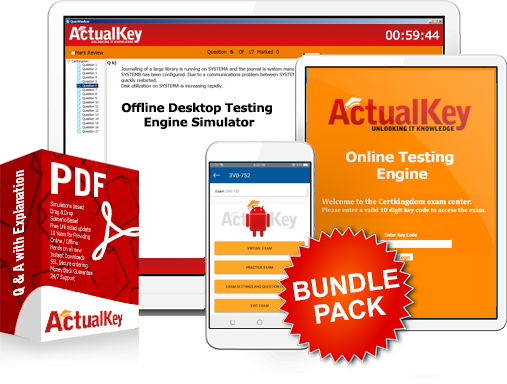
| Bundel Pack Included | PDF + Offline / Andriod Testing Engine and Simulator |
Salesforce Plat-Dev-301 Certified Platform Developer II Exam Preparation Guide
The Salesforce Plat-Dev-301 Certified Platform Developer II Exam is designed for experienced Salesforce developers who possess advanced Apex programming skills, Lightning development expertise, integration knowledge, and the ability to design scalable enterprise applications on the Salesforce Platform. This certification validates your ability to build complex business solutions using Apex, Visualforce, Lightning Web Components (LWC), asynchronous processing, security best practices, testing frameworks, and Salesforce APIs.
Preparing for the Salesforce Plat-Dev-301 exam requires hands-on development experience along with a strong understanding of Salesforce architecture, governor limits, data modeling, application lifecycle management, debugging, and deployment strategies. Practice exams, realistic exam questions, and comprehensive study materials help candidates become familiar with the certification objectives and improve exam readiness.
Whether you are a Salesforce Developer, Technical Lead, Solution Architect, Consultant, or CRM Professional, passing the Salesforce Certified Platform Developer II Exam demonstrates advanced development skills and enhances career opportunities within the Salesforce ecosystem.
Topics Covered in Salesforce Plat-Dev-301 Certified Platform Developer II Exam
Advanced Apex Programming
Apex Design Patterns
Lightning Web Components (LWC)
Aura Components
Visualforce Development
Salesforce Object-Oriented Programming
Governor Limits Optimization
SOQL & SOSL Optimization
Batch Apex
Queueable Apex
Future Methods
Scheduled Apex
Platform Events
Change Data Capture
Salesforce APIs
REST API
SOAP API
Bulk API
Metadata API
Tooling API
Named Credentials
OAuth Authentication
Integration Patterns
External Services
Security and Sharing Model
CRUD & FLS Enforcement
Custom Metadata Types
Custom Settings
Triggers and Trigger Frameworks
Unit Testing
Test Classes
Code Coverage
Mock Callouts
Debug Logs
Performance Optimization
Deployment Strategies
DevOps Center
Salesforce DX
Packaging
Error Handling
Exception Management
What Students Search on ChatGPT, Google, Copilot, Gemini, DeepSeek, Reddit, Facebook & YouTube
Most candidates preparing for the Salesforce Plat-Dev-301 Certified Platform Developer II Exam search for:
Salesforce Plat-Dev-301 exam questions
Salesforce Platform Developer II practice test
Salesforce Plat-Dev-301 dumps
Latest Salesforce Plat-Dev-301 exam guide
Salesforce Platform Developer II study material
Salesforce PDII certification preparation
Salesforce Plat-Dev-301 PDF
Salesforce Platform Developer II mock exams
Apex programming interview questions
Lightning Web Components exam questions
Salesforce asynchronous Apex examples
Salesforce integration scenarios
Platform Developer II exam tips
Salesforce Plat-Dev-301 certification cost
Salesforce Plat-Dev-301 passing score
Salesforce PDII sample questions
Salesforce advanced Apex tutorials
Platform Developer II real exam experience
Salesforce certification roadmap
Best Platform Developer II exam preparation resources
Google Featured Snippet (Short Content)
Preparing for the Salesforce Plat-Dev-301 Certified Platform Developer II Exam requires advanced knowledge of Apex, Lightning Web Components, integrations, APIs, testing, security, and asynchronous processing. Actualkey provides updated practice questions, realistic mock exams, and study materials to help candidates prepare efficiently and confidently.
Question: 1
public class searchFeature {
public static List<List<object>> searchRecords(string searchquery) {
return [FIND :searchquery IN ALL FIELDS RETURNING Account, Opportunity, Lead];
}
}
// Test Class
@isTest
private class searchFeature_Test {
@TestSetup
private static void makeData() {
//insert opportunities, accounts and lead
}
private static searchRecords_Test() {
List<List<object>> records = searchFeature.searchRecords('Test');
System.assertNotEquals(records.size(),0);
}
}
However, when the test runs, no data is returned and the assertion fails. Which edit should the developer make to ensure the test class runs successfully?
A. Enclose the method call within Test.startTest() and Test.stopTest().
B. Implement the seeAllData=true attribute in the @IsTest annotation.
C. Implement the without sharing keyword in the searchFeature Apex class.
D. Implement the setFixedSearchResults method in the test class.
Answer: D
Explanation:
When executing Salesforce Object Search Language (SOSL) queries within an Apex test context, the
search engine does not actually search the database or the records created within the test setup by
default. Instead, it returns an empty result set. This behavior ensures that tests run quickly and
deterministically, without relying on the asynchronous indexing process of the full-text search engine.
To test code that utilizes SOSL, developers must define the expected search results explicitly using
the Test.setFixedSearchResults(recordIds) method. This method accepts a list of Record IDs that the
FIND clause should return. By implementing setFixedSearchResults in the test method before calling
the searchFeature.searchRecords method, the SOSL query will return the specified test records,
allowing the System.assertNotEquals assertion to pass. Options A (startTest/stopTest) helps with
governor limits but does not fix SOSL results. Option B (SeeAllData) is generally discouraged and does
not guarantee SOSL indexing availability. Option C (without sharing) affects record visibility but does
not force the search engine to return un-indexed test data.
Question: 2
A developer is asked to look into an issue where a scheduled Apex is running into DML limits.
Upon investigation, the developer finds that the number of records processed by the scheduled Apex has
recently increased to more than 10,000. What should the developer do to eliminate the limit exception error?
A. Implement the Batchable interface.
B. Use platform events.
C. Use the @future annotation.
D. Implement the Queueable interface.
Answer: A
Explanation:
The issue described involves hitting DML limits due to a high volume of records (over 10,000) being
processed in a single transaction. In Salesforce, a single synchronous transaction or a standard
Scheduled Apex job has strict governor limits on the number of DML statements (150) and the total
number of records processed (10,000 for DML rows).
To resolve this, the developer should implement the Database.Batchable interface. Batch Apex is
specifically designed to handle large data volumes by breaking the processing into smaller,
manageable chunks (batches) of records (default 200). Each batch runs within its own transaction
context, resetting the governor limits for that specific batch. This prevents the "Too many DML rows"
exception. While Queueable (Option D) and @future (Option C) provide asynchronous processing,
they are not inherently designed to iterate over large datasets in the same robust, governor-limitsafe
manner as Batch Apex, particularly when the record count exceeds the thousands.
Question: 3
A Lightning web component exists in the system and displays information about the record in context
as a modal. Salesforce administrators need to use this component within the Lightning App Builder.
Which two settings should the developer configure within the xml resource file?
A. Set the 'IsVisible' attribute to 'true'.
B. Set the 'IsExposed' attribute to 'true'.
C. Specify the 'target' to be 'lightning__RecordPage'.
D. Specify the 'target' to be 'lightning__AppPage'.
Answer: B, C
Explanation:
To make a Lightning Web Component (LWC) available for use in the Lightning App Builder, the
developer must modify the component's configuration file (the .js-meta.xml file).
First, the isExposed tag must be set to true. By default, this is false, meaning the component is only
available to other components within the namespace but not to the App Builder or Experience
Builder. Setting it to true exposes it to the tools.
Second, the developer must specify where the component can be dragged and dropped by defining
targets. Since the question states the component displays information about the "record in context,"
it implies the component is designed to live on a Record Page. Therefore, adding
<target>lightning__RecordPage</target> is essential. While lightning__AppPage (Option D) is a valid
target, the context of "record in context" strongly points to the Record Page target.
There is no IsVisible attribute in the LWC configuration schema.
Question: 4
A Salesforce org has more than 50,000 contacts. A new business process requires a calculation that
aggregates data from all of these contact records. This calculation needs to run once a day after
business hours. Which two steps should a developer take to accomplish this?
A. Use the @future annotation.
B. Implement the Database.Batchable interface.
C. Implement the Schedulable interface.
D. Implement the Queueable interface.
Answer: B, C
Explanation:
This scenario presents two distinct requirements: processing a large volume of data (50,000 records)
and running the process at a specific time (once a day after business hours).
Database.Batchable (Option B): Processing 50,000 records in a single synchronous transaction will
exceed Apex Governor Limits (specifically the CPU time limit or the heap size limit). Batch Apex
allows the system to process these records in smaller chunks (batches), ensuring that the calculation
completes without hitting limits.
Schedulable (Option C): To ensure the job runs "once a day after business hours," the Schedulable
interface is required. The developer allows the class to be scheduled via the Apex Scheduler or the UI.
The standard pattern for this use case is to create a class that implements Schedulable, and inside its
execute method, instantiate and execute the Batch class (Database.executeBatch). This combines
precise timing with bulk processing capabilities.
Question: 5
A developer is writing a Visualforce page that queries accounts in the system and presents a data
table with the results. The users want to be able to filter the results based on up to five fields.
However, the users want to pick the five fields to use as filter fields when they run the page. Which
Apex code feature is required to facilitate this solution?
A. Dynamic SOQL
B. Metadata API
C. Streaming API
D. Variable binding
Answer: A
Explanation:
The requirement is to allow users to select which fields they want to filter by at runtime. In standard
(static) SOQL, the fields in the WHERE clause must be defined at compile time (e.g., WHERE Name =
:val). Because the fields themselves are not known until the user interacts with the page, the
developer cannot write a static query.
Dynamic SOQL is the required feature. It allows the developer to construct the SOQL query string as a
text string at runtime, incorporating the specific field names selected by the user, and then execute
that string using Database.query(queryString). This provides the flexibility to build queries on the fly
based on user input. Metadata API is for configuration changes, Streaming API is for push
notifications, and Variable binding (:var) is used in both static and dynamic SOQL but does not solve
the issue of changing the field names themselves.
Lucas Martin - Canada
The practice exams closely matched the real exam. Highly recommended.
Emily Parker - Australia
Excellent explanations and realistic questions helped me pass confidently.
Oliver Hansen - Denmark
Very accurate content with great coverage of Apex and Lightning topics.
Maria Gomez - Spain
The mock exams significantly improved my confidence before the certification.
Daniel Brooks - United States
The testing engine simulated the real exam perfectly.
Aisha Rahman - Bangladesh
Updated questions and detailed answers made studying much easier.
Ethan Cooper - New Zealand
Fantastic practice materials with excellent coverage of integrations.
Noah Wilson - United Kingdom
Worth every minute of study. Passed on my first attempt.
Fatima Noor - United Arab Emirates
The explanations helped me understand advanced development concepts.
Kevin Tan - Singapore
Professional-quality practice tests and very accurate content.
Sophia Klein - Germany
The questions reflected the real certification objectives.
Ahmed Hassan - Egypt
One of the best resources available for Platform Developer II preparation.
Isabella Rossi - Italy
Excellent study package with challenging practice questions.
Mateusz Kowalski - Poland
Comprehensive content that covered every important exam topic.
Grace Mitchell - Ireland
Passed the exam successfully thanks to the realistic practice environment.
1. What is the Salesforce Plat-Dev-301 Certified Platform Developer II Exam?
It is an advanced Salesforce certification that validates expertise in Apex, Lightning development, integrations, security, testing, and enterprise application design.
2. Who should take the Plat-Dev-301 exam?
Experienced Salesforce developers with strong hands-on development experience.
3. Is Platform Developer II harder than Platform Developer I?
Yes. It focuses on advanced development concepts and enterprise-level implementation.
4. What topics are covered in the exam?
Advanced Apex, LWC, APIs, integrations, testing, security, asynchronous processing, deployment, and performance optimization.
5. How much Apex knowledge is required?
Candidates should have strong experience with advanced Apex programming and best practices.
6. Are Lightning Web Components included?
Yes. LWC development is a major exam objective.
7. How important are integration questions?
Very important. REST, SOAP, OAuth, Named Credentials, and integration patterns are frequently tested.
8. What is the best way to prepare?
Study the official objectives, practice coding, and take realistic mock exams.
9. Are practice exams useful?
Yes. They improve familiarity with exam format and identify knowledge gaps.
10. How long should I study?
Most successful candidates spend several weeks practicing advanced Salesforce development concepts.
11. Is hands-on experience necessary?
Yes. Practical development experience greatly improves your chances of passing.
12. What programming skills are required?
Advanced Apex, SOQL, Lightning Web Components, Visualforce, triggers, testing, and API integrations.
13. Can beginners take this exam?
It is intended for experienced Salesforce developers rather than beginners.
14. What careers benefit from this certification?
Salesforce Developer, Senior Developer, Technical Lead, Solution Architect, Application Developer, and Salesforce Consultant.
15. Why choose Actualkey for exam preparation?
Actualkey provides updated practice questions, realistic testing software, comprehensive study materials, and mock exams designed to help candidates prepare effectively for the Salesforce Plat-Dev-301 Certified Platform Developer II Exam.
Exams code, certifications, vendor or keywords

Copyright © 2009 - 2026 Actualkey. All rights reserved.